ISO 20022: What It Is and How to Use It
Understanding ISO 20022 to Master the Future of Payments
Talking about ISO 20022 is talking about the new universal language of money. This standard is not only modernizing the way banks communicate—it is redefining how the global financial ecosystem works. Between international transfers, instant payments, institutional cryptocurrencies, clearing systems and central banks, the adoption of ISO 20022 marks the beginning of a new era in which data becomes as important as money itself.
You will discover what ISO 20022 is, why the world’s major financial systems are adopting it, how it works in practice, how you can use it and what it means for businesses, developers, financial institutions and anyone interested in the future of fintech.
What Is ISO 20022 and How to Use It?
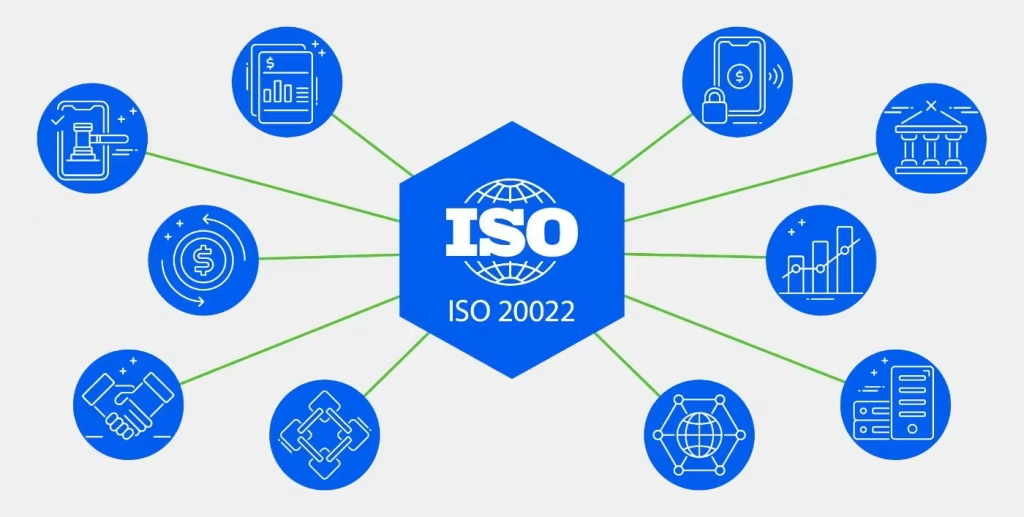
ISO 20022 is an international standard designed to improve communication between financial systems. It was created by the International Organization for Standardization (ISO) with a simple yet ambitious goal: to make all financial systems speak the same language.
More specifically:
ISO 20022 defines a standardized, structured language for financial messages, based on XML and modern data formats that allow greater clarity, interoperability and detail in every transaction.
In other words, ISO 20022 is not software, not a platform, and not a currency. It is a unified, precise, global way of sending financial information between banks, payment systems, companies and regulators.
Why Was ISO 20022 Created?
For decades, the global financial system relied on legacy protocols like SWIFT MT messages. They worked, but were limited: restricted character counts, rigid formats and little capacity for rich data. With the exponential growth of e-commerce, anti-fraud regulations and the need for fast, transparent payments, it became clear that the world needed a modern standard.
ISO 20022 solves these problems by providing:
- Richer data in every message
- Higher accuracy in payer and payee identification
- Fewer errors and fewer rejected transactions
- Better automation capabilities
- Enhanced compatibility for audits, monitoring and compliance
- A flexible language for payments, securities, treasury, trade finance and more
Because of these advantages, central banks, international payment systems and major tech providers began adopting the new standard.
Systems Already Using or Migrating to ISO 20022
ISO 20022 already powers a significant portion of global payments. Systems adopting or migrating include:
- SWIFT (international messaging)
- TARGET2 and TIPS (European Union)
- Fedwire and CHIPS (United States)
- Bank of England RTGS
- Instant payment systems like UPI, PIX, NPP, SEPA, among others
- Central bank digital currency (CBDC) projects
- Financial market infrastructures such as clearing and securities settlement
The reason is simple: ISO 20022 supports financial digitalization, automation and global trade growth—something older standards can no longer do efficiently.
How ISO 20022 Works
To understand how to use ISO 20022, you must first understand its structure. The standard consists of three essential pillars:
- Business Model:
Describes financial processes such as payments, collections, transfers and reporting. It defines the information required for each operation. - Message Model:
From the business model, standardized messages are created. For example:- PACS for payments
- CAMT for cash management
- PAIN for customer instructions
- Data Syntax (XML or JSON):
Messages are structured using modern languages that allow detailed, orderly and machine-readable data.
The result: detailed, consistent messages that can be fully processed by automated systems.
Practical Example of an ISO 20022 Payment Message
A payment message under ISO 20022 can include:
- Full payer information
- Full beneficiary information
- Detailed payment purpose
- Unique identifiers
- Tax information
- Exchange rate data
- Extended regulatory details
- Extra fields for auditing or reconciliation
This level of detail reduces errors, improves transparency and speeds up end-to-end processing.
How to Use ISO 20022 in Practice
Using ISO 20022 depends on your role in the financial ecosystem. Here are the most important practical applications.

1. How Banks and Financial Institutions Use ISO 20022
Banks implement ISO 20022 by modernizing their payment systems. This includes:
- Migrating internal platforms to XML-compatible formats
- Coordinating with domestic and international clearing houses
- Updating core banking systems
- Adapting AML and fraud-monitoring systems
- Aligning regulatory reporting processes
The main benefit is end-to-end automation, which reduces operational costs and improves customer experience.
2. How Companies Use ISO 20022
Companies managing mass payments or high financial volume also benefit greatly.
Advantages include:
- Automatic payment reconciliation
- More precise electronic invoicing
- Fewer rejected transfers
- Higher efficiency in ERP and CRM systems
A company using ISO 20022 can process thousands of payments with fewer errors and in less time.
3. How Developers and Fintech Programmers Use ISO 20022
For developers, ISO 20022 is a competitive advantage because it enables the creation of fully interoperable financial applications.
Use cases:
- Banking API integration
- Open banking solutions
- Instant payment systems
- Wallet, lending or remittance platforms
And because it is based on XML with well-documented models, implementation is far clearer than with legacy standards.
4. How Institutional Crypto and CBDC Systems Use ISO 20022
Many central banks are designing CBDC systems based on ISO 20022. The reason?
- Built-in compliance
- Rich regulatory data
- Traceability
- Advanced auditing capabilities
If institutional digital currencies expand globally, ISO 20022 will be a fundamental component of their infrastructure.
5. How Consumers Benefit from ISO 20022
Although everyday users don’t interact directly with the standard, they benefit from:
- Faster payments
- Cheaper international transfers
- Fewer transfer errors
- More transparent banking information
- Improved digital security
Behind almost every smooth, error-free transfer, there is likely an ISO 20022 message at work.
Why ISO 20022 Is So Important
In summary, ISO 20022 matters because it brings:
- Global interoperability
- Richer data
- Better automation
- Compatibility with modern technology
- Support for instant payment ecosystems
- Integrated regulatory compliance
- Reduced errors and lower costs
It is the language of modern digital finance, built for the global economy of the future.
How to Prepare to Work With ISO 20022
Depending on your professional profile, these steps can help:
For Financial Professionals:
- Learn PAIN, PACS and CAMT message types
- Study XML in a financial context
- Understand cross-border payment workflows
For Developers:
- Examine ISO 20022 XSD models
- Work with XML validation tools
- Explore banking APIs already compatible
For Businesses:
- Confirm whether your ERP or accounting software supports ISO 20022
- Update mass-payment processes
- Coordinate migration with your bank
For Fintech Entrepreneurs:
- Build ISO-compatible products from day one
- Use data richness for analytics and automation
- Leverage the standard to connect with global systems
Myths and Realities About ISO 20022
Let’s clarify common misconceptions:
❌ Myth: ISO 20022 is a cryptocurrency
✔️ Reality: It is a messaging standard, not a currency.
❌ Myth: Banks will stop using SWIFT
✔️ Reality: SWIFT will continue operating, now carrying ISO 20022 messages.
❌ Myth: It is mandatory for everyday users
✔️ Reality: It is mandatory for banks and systems, not for consumers.
❌ Myth: It is extremely difficult to implement
✔️ Reality: It is more flexible and modern than previous standards.
What Changes Will ISO 20022 Bring in the Coming Years?
Expected impacts include:
- Faster international payments
- Greater clarity in remittances
- More transparency for banks and regulators
- Better fraud detection and prevention
- Nearly complete automation of payment workflows
- A truly global instant-payments ecosystem
- Seamless integration between banks, fintechs and merchants
The standard will make transactions safer, faster and more affordable.

Conclusion: ISO 20022 as a Pillar of the Financial Future
ISO 20022 is not a trend or a temporary project—it is the new universal language of money. Its goal is to create a standardized, modern, fully interoperable financial system. It is already transforming banks, businesses, instant payments and cross-border systems. The sooner a company or institution adapts, the more competitive it becomes.
For the general public, it means faster and safer payments. For banks, operational efficiency. For developers, new opportunities. And for the global economy, a leap toward a smart, connected financial environment ready for the future.